The Storage Supercycle Is Here - Can Cleanroom IPC Maintenance Still Rely on Sending People In?
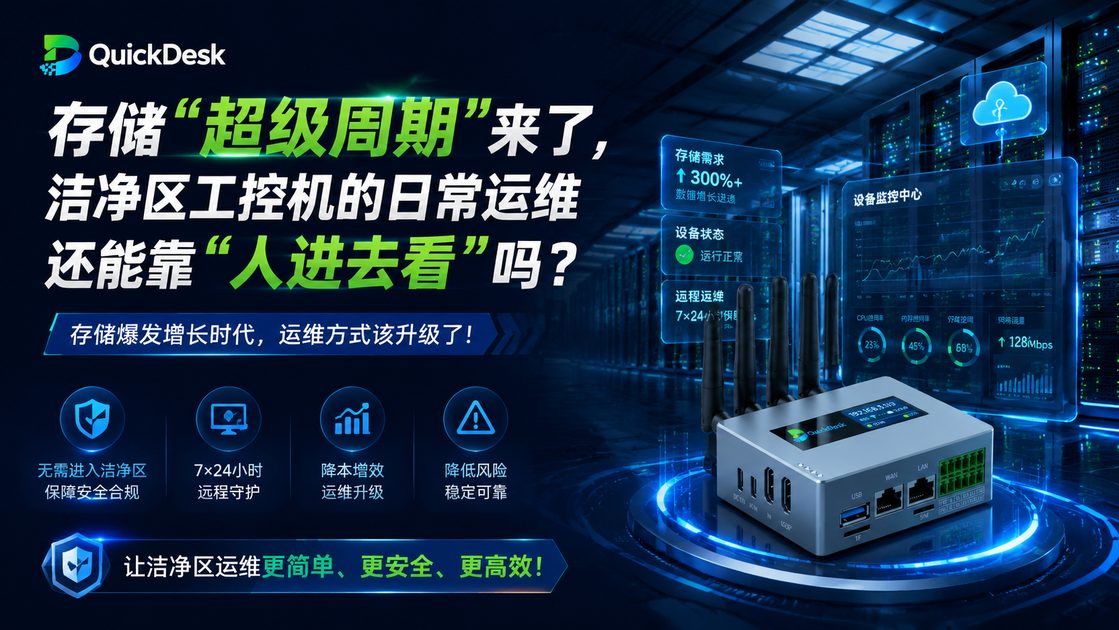
The Storage Supercycle Is Here - Can Cleanroom IPC Maintenance Still Rely on Sending People In?
In the cleanroom of a fab, engineers need to "go in and take a look" every single day.
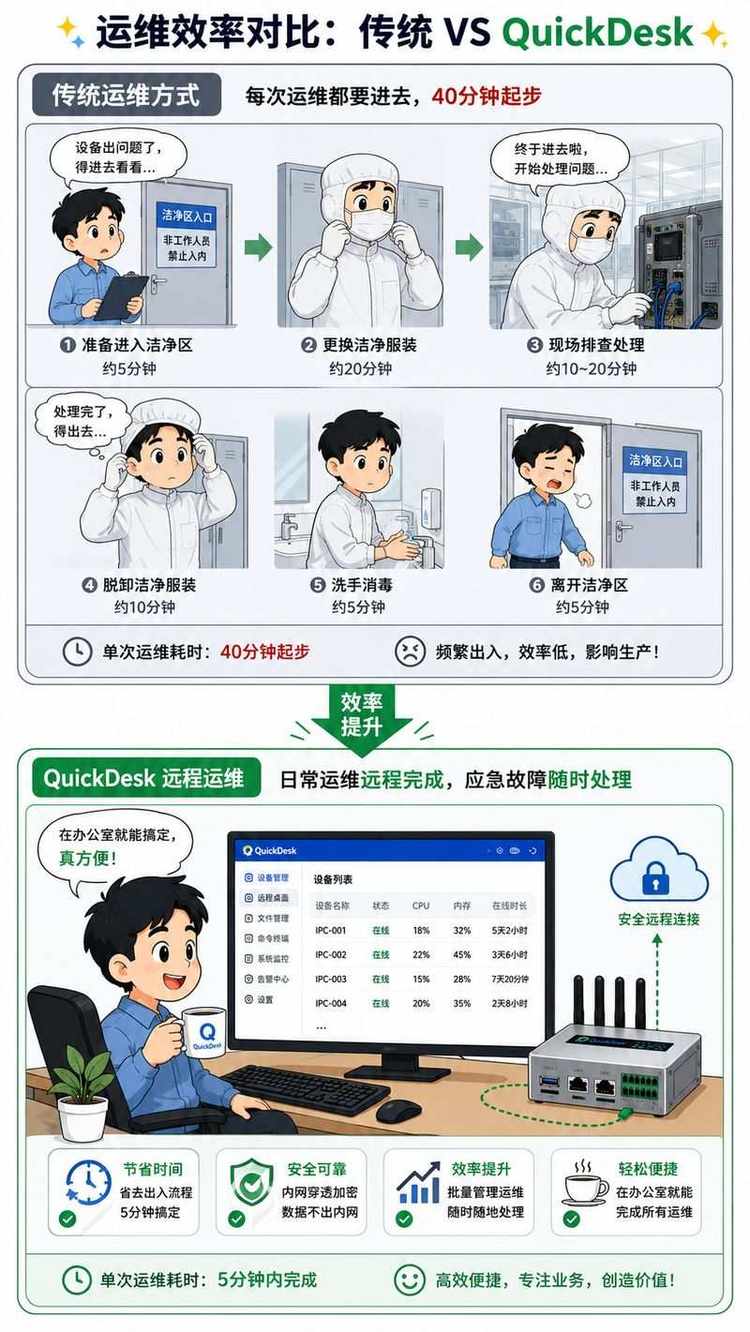
Equipment inspections, log checks, patching, parameter adjustments... each entry takes at least 40 minutes, plus gowning and air showers.
Over a year, maintaining a single industrial PC means dozens of cleanroom entries. Multiply that across many machines, and the number becomes significant.
Every entry is a disturbance to the clean environment.
The QuickDesk cleanroom IPC remote O&M solution lets engineers complete daily maintenance of cleanroom industrial PCs from the office. Nobody goes in - maintenance goes on as usual.
Even better: private deployment is supported. Software and hardware both run inside the customer's internal network, data never leaves the intranet, meeting security and compliance requirements.
1. The Daily Maintenance Dilemma in Cleanrooms
Daily maintenance generates plenty of "entry" needs - but the entry itself is the cost.
Cleanrooms strictly control particulate contamination. Every person entering introduces particles that can affect yield. In high-value process areas such as lithography and etching, the impact of each entry is amplified further.
If you try to handle these tasks with remote software instead, two problems arise: software remote control can't reach the lower layer (it depends on the OS), and it may not be allowed to be installed at all (compliance).
Take a look at your own daily maintenance - are you facing the same dilemma?
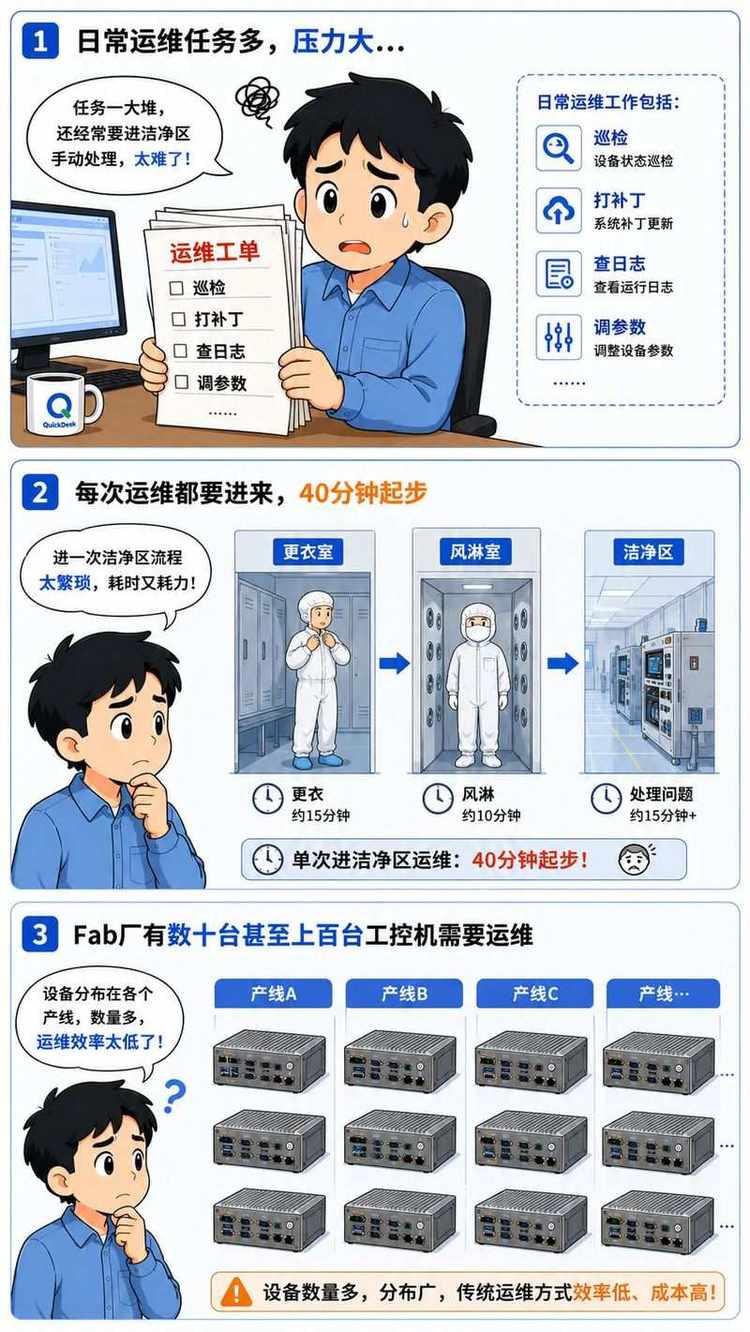
The storage market is now in a supercycle: DRAM prices up 93% in a single quarter, NAND up tenfold. With capacity maxed out, IPC maintenance demands only keep growing.
Equipment is running at full load, making routine inspections and preventive maintenance more important than ever. Yet the maintenance model hasn't upgraded - it's still the 1.0 era of "send a person in to look."
2. Three Core Capabilities of QuickDesk
QuickDesk brings a new approach to daily cleanroom IPC maintenance.
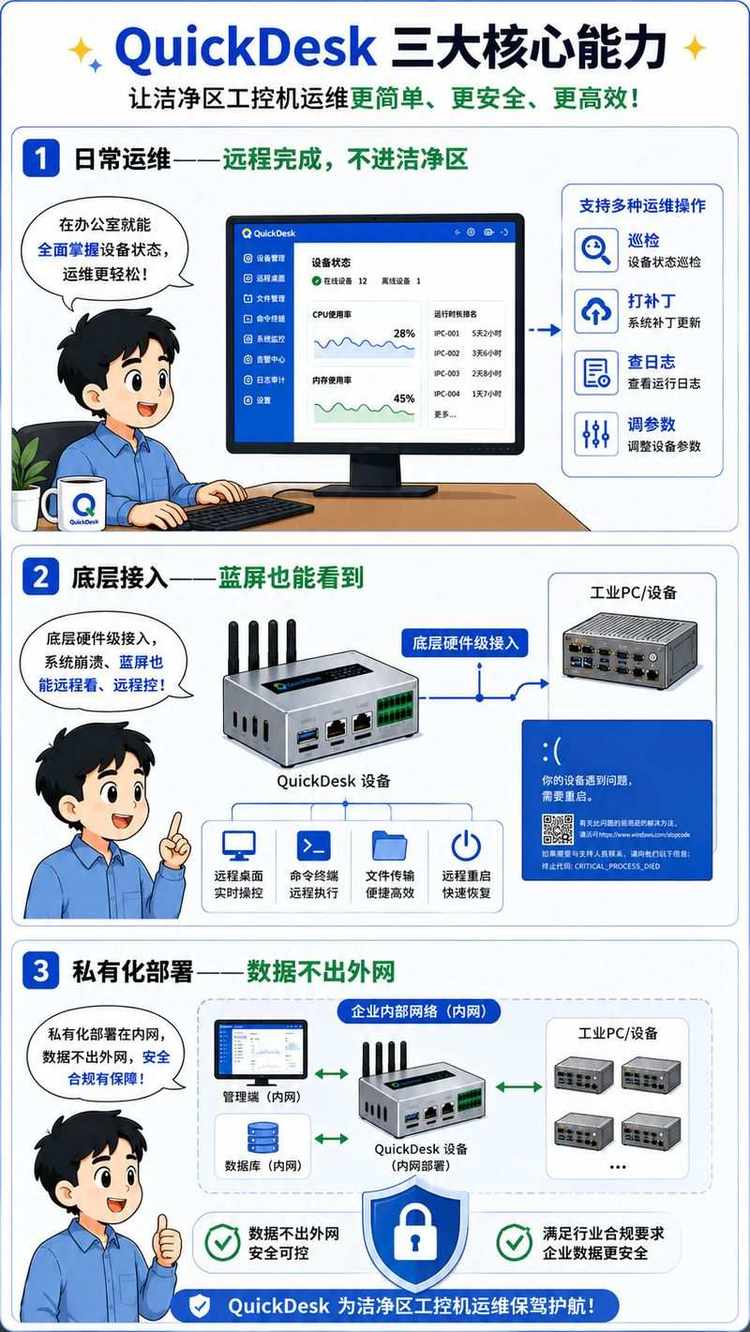
In short, QuickDesk does three things:
First, daily maintenance - done remotely.
Engineers complete routine inspections, software upkeep, and parameter adjustments from the office. No gowning, no air showers, no disturbance to the production environment.
Second, low-level access - visible even through a blue screen.
Through pure-hardware HDMI and USB connections, QuickDesk depends neither on the IPC's operating system nor on any installed software. Blue screen, stuck in BIOS - as long as there's power and video output, you can see it and control it.
Third, private deployment - data never leaves the intranet.
Software and hardware both run inside the customer's internal network; all O&M data stays within it. This meets MLPS requirements, industrial internet security requirements, and industry rules that production data must never leave the plant network.
3. How Daily Maintenance Gets Done
Here are a few concrete scenarios showing how QuickDesk makes "no entry" a reality.
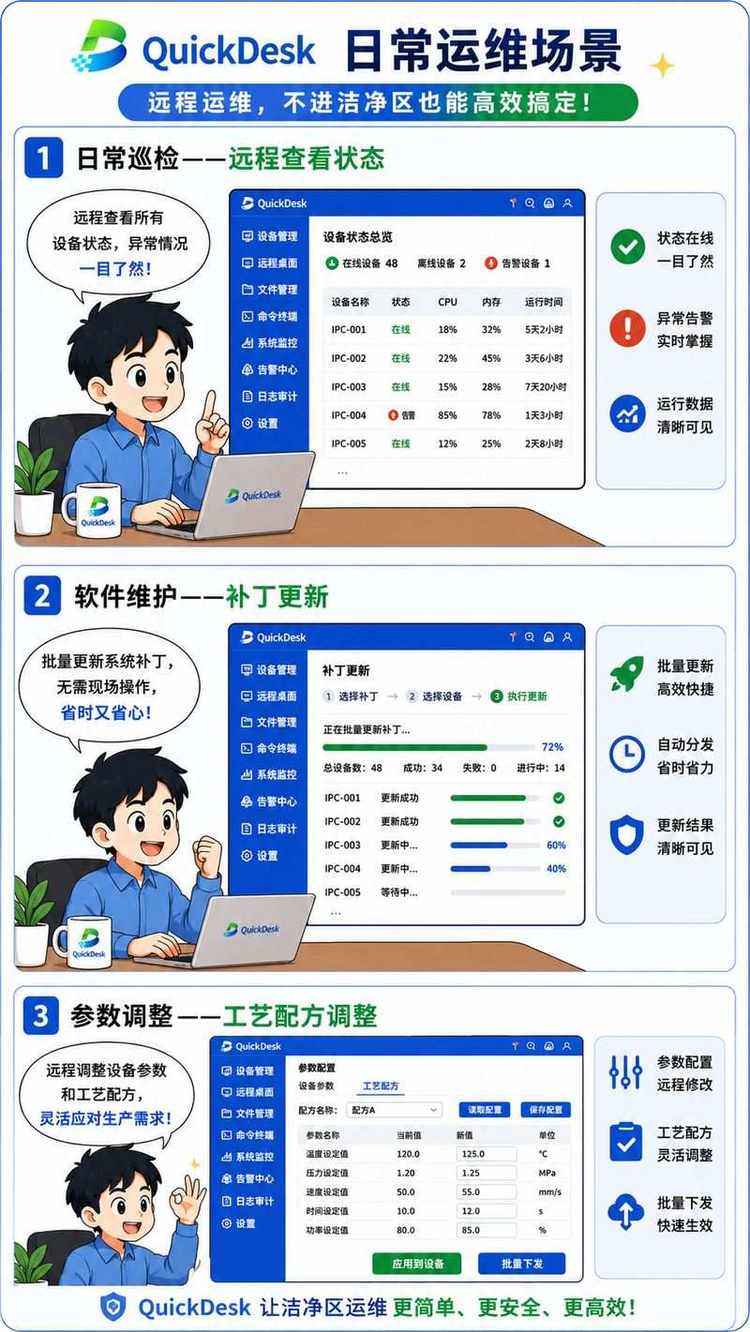
Routine inspections: check IPC status remotely - is the system healthy, is disk space sufficient, any anomalies in the logs - all from your desk.
Software maintenance: patch IPCs and update drivers remotely, no gowning up and walking in.
Parameter adjustments: change process recipes or alarm thresholds via remote login - no downtime waiting, no gowning up.
4. Emergencies Handled Anytime
Beyond daily maintenance, QuickDesk also shines when an IPC actually fails.
Blue screen? Force a remote restart. Wrong parameters? Fix them remotely. Boot failure? Mount a recovery image remotely.
Whatever the low-level fault, as long as the IPC has power and video output, QuickDesk can take over remotely and address the problem immediately.
Here's how the approaches compare:
| Approach | Daily Maintenance | Low-Level Faults | Data Security | Deployment |
|---|---|---|---|---|
| Send someone on site | Entry required every time | Handled | Data stays on intranet | N/A |
| Traditional remote software | Zero entry | Depends on the OS | Depends on cloud | Cloud |
| QuickDesk | Done remotely | Even blue screens | Private option | Cloud / Private |
5. Why Choose QuickDesk?
Some may ask: why not just replace people with remote software? But software remote control doesn't work well in fabs -
Four problems with software remote control:
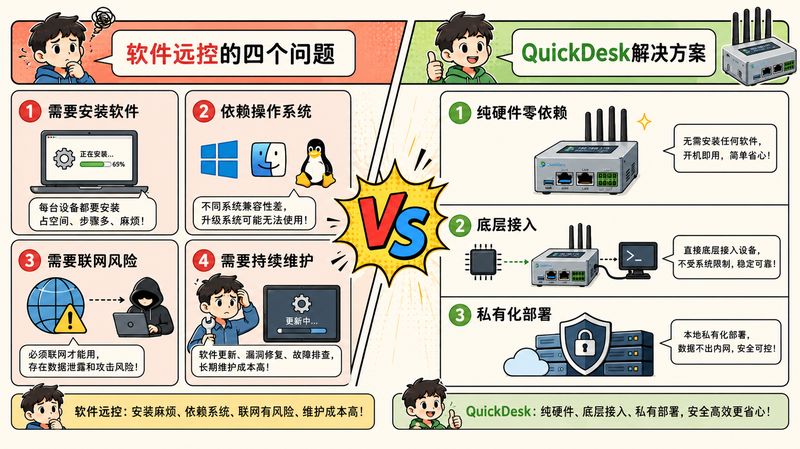
QuickDesk offers a different path - a pure-hardware solution, software-independent, with data that never leaves the intranet.
1. Daily maintenance done remotely, fewer cleanroom entries
Engineers complete routine inspections, software maintenance, and parameter adjustments from the office. No gowning, no air showers, no disturbance to production.
2. Private deployment, data never leaves the intranet
Software and hardware run inside the customer's intranet; production data flows only within it. Meets industrial internet security and industry compliance requirements.
3. Low-level access, broader applicability
Whatever state the IPC is in - as long as it has power and video output, remote takeover works. Daily maintenance and emergency faults alike.
4. Pure hardware, zero software dependency
Consumes no software resources on the IPC, affects no existing control systems, and meets the compliance requirements of high-security environments.
6. The Value of Private Deployment
For fabs, pharmaceutical workshops, and other customers with high security and compliance requirements, private deployment is a hard requirement.
Here's how data stays off the public internet:
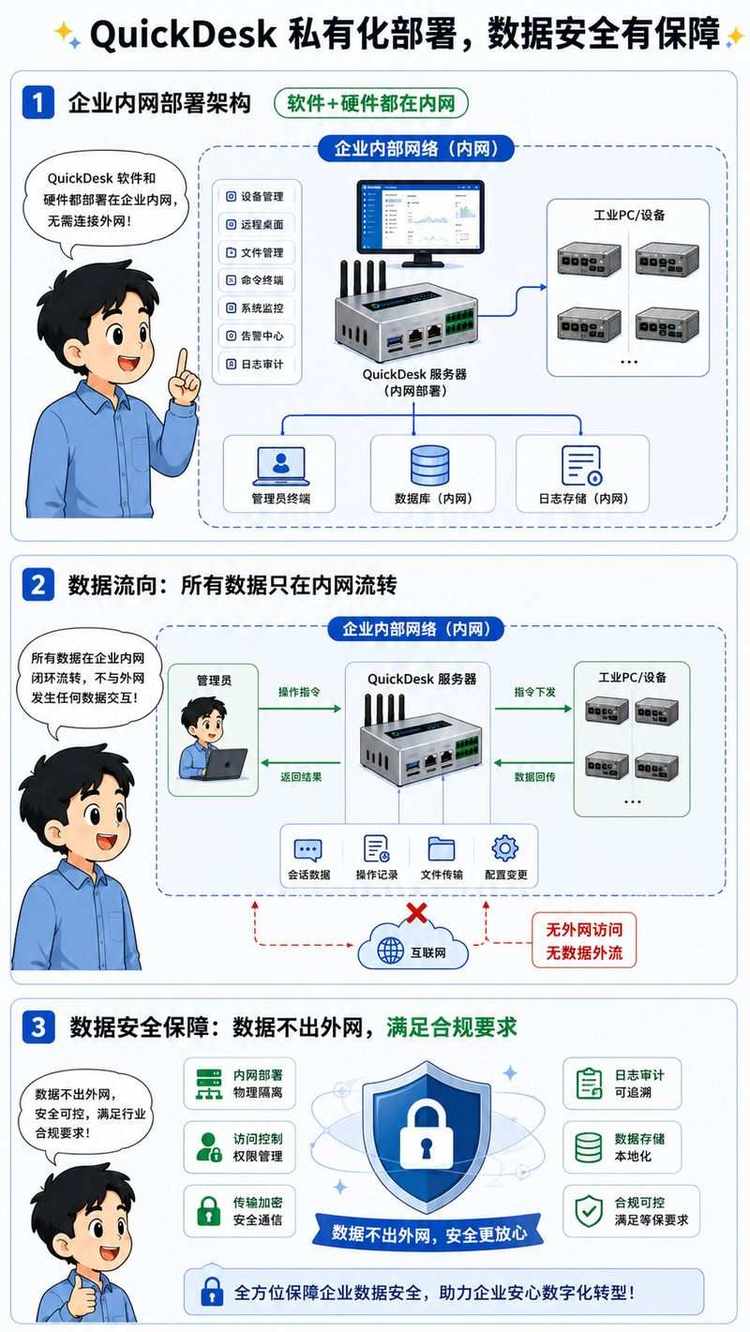
In short, private deployment means:
- Software deployed on the customer's intranet servers, no cloud dependency
- Hardware running inside the customer's intranet, closed data flow
- Remote access through the customer's intranet, never exposed to the public internet
All O&M data, operation records, and screen streams flow only within the customer's own network - meeting MLPS, industrial internet security, and industry compliance requirements that production data must not leave the plant.
Summary
In the storage supercycle, capacity is maxed out - and so is the maintenance burden.
The QuickDesk cleanroom IPC remote O&M solution lets engineers handle daily maintenance from the office - nobody goes in, maintenance goes on as usual.
Routine inspections, software upkeep, and parameter adjustments can all be done remotely - and when emergencies strike, they can be handled remotely too.
Private deployment is supported, data never leaves the intranet, meeting the strictest security and compliance requirements.
Interested in remote O&M for cleanroom industrial PCs? Scan the QR code to talk to us.